

Ayurveda is the science that indicates the appropriate and inappropriate, happy or sorrowful conditions of living, what is auspicious or inauspicious for longevity, as well as the measure of life itself.
- CHARAKA SAMHITA I. 41
Ayurvedic medicine is the 5000 year old, ancient healing system of India, which promotes health using natural nontoxic substances and which recognises the central role of the mind and emotions.
In Ayurveda, the physical body is the gateway to the energy body, and the energy body serves as the bridge to the spiritual self or Atman, which is born from the Paramātmā or the Supreme Self.
There is truly only one healing force in the universe and that is Nature herself. For eons Nature has birthed, grown, decayed and re-birthed. The beauty and intricate balance of nature is a magnificent demonstration of coherence. Without interference, propelled by an intelligence beyond our understanding. Yet we have become so disconnected from this very core of our being.
When we align with this truth, almost all imbalance is curable. We just have to discover our own unique path to wellness and surrender to the Supreme.
According to ancient Indian texts, a human must pursue ‘Purushartha’, (पुरुषार्थ) – translated as “object of human pursuit”.
This key concept in Ayurveda refers to the four end goals or purposes of a human life.
The four Purushartha are:
- Dharma (righteousness, moral values)
- Artha (prosperity, economic values)
- Kama (creative pleasure, love, psychological values)
- Moksha (liberation, spiritual values)
The ultimate goal of human life is “Moksha”. “Moksha” means self-realisation which is the state of the complete cessation of all suffering – both physically and mentally. This can be difficult to achieve if the body is riddled with disease and imbalance. Health becomes a spiritual pursuit and vice versa. The gross body is connected to the energy body, mind and spirit. We intuitively know this to be true. Yet we constantly identify with the material world.
Dis- ease is the process of forgetting that we are and have come from a field of conscious awareness. This is when we start to identify with the material world. We cannot truly heal without changing and healing the biochemistry of the burdened emotional self, we do this by regulating the autonomic nervous system and processing the experiences of the past.
This paradigm acknowledges the mutual interdependence of the physical body, mind, emotions, and the environment creating health and disease. This means there is a shared responsibility between practitioner and patient. The patient must choose to be healthy, take the necessary steps to heal by changing their habit patterns and thus heal themselves.
To comprehend how this is possible, we must understand the body itself. Physics informs us that the basic fabric of nature in the quantum level, far beyond atoms and molecules – A quantum, defined as the basic unit of matter or energy, is 10,000,000 to 100,000,000 times smaller than the smallest atom. At this level matter and energy become interchangeable. Ayurveda says that the same is true for the human body, these subatomic particles are the underlying basis for everything we are: thoughts, emotions, proteins, cells, organs – any visible or invisible part of ourselves.
Ayurveda holds that all the organs and processes in the body have a quantum equivalent, which practitioners use to understand a patient’s bio-individuality or Dosha.
“Dosha” can be translated as that which darkens, decays or spoils. Think of them as “triggers” that we inherit genetically from our parents. Although we inherent some of these (epigenetic) triggers, we do not have to allow them to control our behaviour. Understanding, these bio-individual, genetic predispositions can be greatly helpful in our life-long pursuit vitality and self-realisation.
An Ayurvedic Practitioner uses a pulse and tongue assessment to establish Prakriti (innate constitution when in balance) and Vrikriti (विकृति) refers to the “change in shape and form” or state of imbalances. The practitioner then works with the patient to establish a wide range of practices to bring about balance to the doshas – Including:
- Ayurvedic diet & food energetics
- Understanding the patterns of imbalance
- Life regimens
- Herbal medicine
- Oils & body work therapies
- Colour & gems
- Aromatherapy
- Life-style, including exercise, relationships, nature therapy
- Yoga Chikitsa (Therapy)
- Mantra
- Meditation
- Pranayama (Breath work)
- Yoga psychology
- Detoxification & panchakarma
These practical applications gently shape the autonomic nervous system, and refine the skill of regulating our response to the ordinary, and extraordinary challenges we meet each day. By learning to conserve the life force energy within our bodies, so that it will no longer disperse and weaken as a result of our worldly interactions.
Living with perfect health and vitality requires that we avoid being drained of this energy, and develop the physical body into an efficient and healthy organism, able to live in the world, and yet stay free of the tensions and stresses of daily life.
Able to heal oneself, love oneself and love others.
It is an empowering state – physically, emotionally, mentally, spiritually – allowing us to become our best, most alive selves.
Written by Taleszia Raubenheimer – Ayurvedic practitioner & Herbalist.
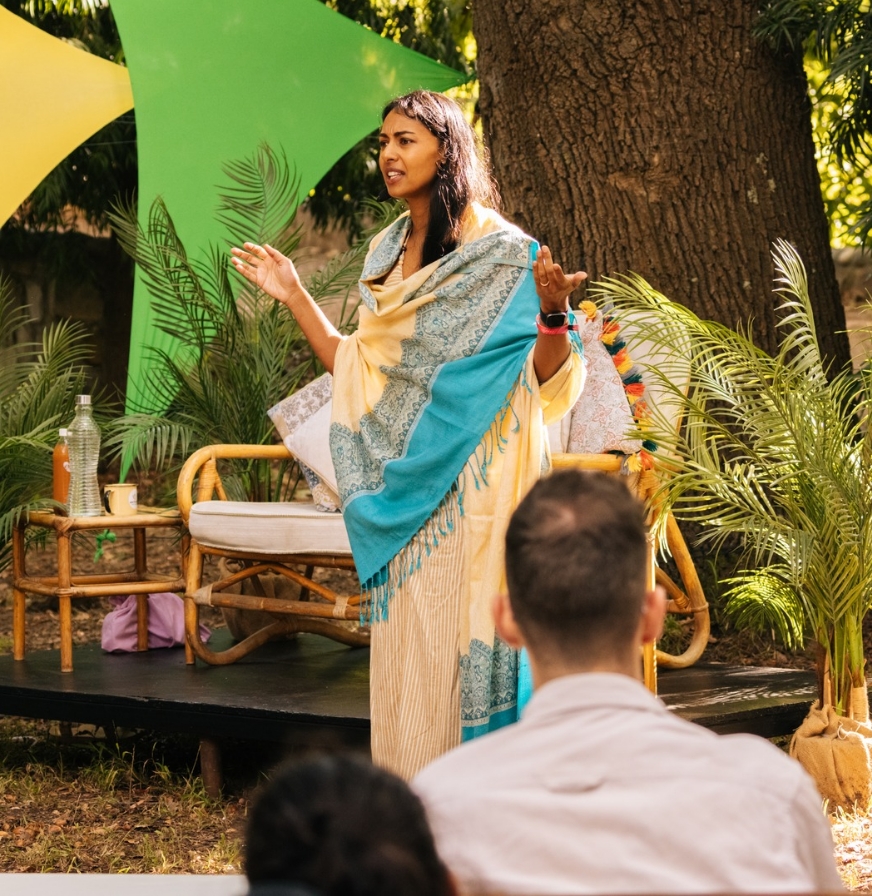 Taleszia Raubenheimer is a skilled Ayurvedic practitioner and herbalist with a holistic approach to healing that integrates the physical, energy, and mental bodies. With training in Integrative Health Sciences and Polyvagal Theory, Taleszia combines ancient wisdom with modern science to support the body’s natural ability to heal and thrive.